
Dental Implants
Restore missing teeth with Dental Implants
Long term solutions for those who need a missing tooth replaced in Beverly Hills, CA
Dental implants are a great option for people who have lost one or more teeth, or who have not been able to keep their natural teeth due to periodontal disease. They’re also great for people looking to improve their smile appearance. Dental implants are real, permanent teeth that are custom-crafted in a dental lab, and then surgically installed in your mouth
What are dental implants ?
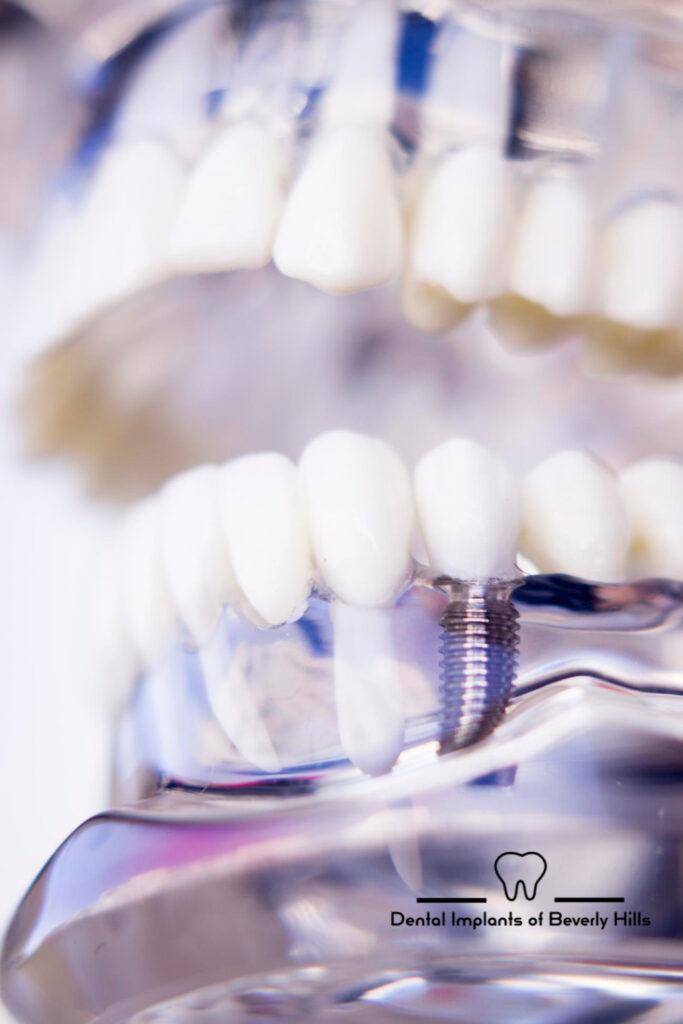
Dental implants are a comprehensive solution for those missing one or more teeth. A dental implant is an artificial tooth root that goes into your jawbone to anchor an artificial tooth or teeth. A dental implant tooth can be used to anchor a fixed bridge, replace a single missing tooth, or support an entire arch of replacement teeth. Unlike dentures, implants don’t cover your real teeth and gums; instead, they integrate with them within your mouth.
For years in Beverly Hills and Los Angeles, dental implants have been a reliable, comfortable, and safe option for replacing missing teeth. These restorative fixtures look and feel very much like original teeth, but have the added benefit of mimicking the way real teeth anchor into bone. Dental implants can be used to replace one tooth or an entire arch of teeth. In some cases, implants can also be used as a foundation for replacement teeth. Implants can be made of various materials, including titanium and porcelain. They’re the best, most permanent solution for replacing missing teeth and provide the highest quality of life because they are just like your natural teeth. An implant-supported crown or bridge is mechanically strong, helping you speak, eat and chew with ease.
Benefits of Dental Implants
Dental implants provide a permanent solution to replace missing teeth, allowing you to eat, speak and smile with confidence. They are a great option for those who have lost one or more teeth because they offer the same chewing function as your natural teeth. You’ll be able to maintain the same quality of life you always enjoyed because dental implants don’t impact your speech pattern or bite. Dental implants are a replacement for a missing tooth that provides structural support for your mouth and also allow you to eat, speak and look great. Dental implants beverly hills have multiple benefits, including: improved chewing capabilities, a natural appearance for your new teeth, and no need for dentures.
Dental implants offer many benefits to patients who need a new tooth that is strong and stable. Unlike dentures, dental implants don’t require you to change them every night, so you can eat what you want and not worry about fitting them over an evening meal. They are also a great long-term solution if you experience serious tooth loss because they will last for years or decades without running the risk of needing costly treatments down the line due to gum disease.
Benefits also include:
- Longer-lasting, healthier teeth
- Increased aesthetics of your smile
- Improved appearance in photos
- Ability to enjoy all foods including those that require chewing and masticating
- Less sensitive teeth
- Reduced risk of gum disease
Types of Implants available in Beverly Hills
Dental implants are designed to support natural-looking dental crowns, bridges, and partial dentures. They are inserted into bone, where they fuse with the surrounding tissue. Dental implants last a lifetime and come in many different shapes, sizes and materials.
There are many types of dental implants available today. Depending on the condition of your teeth, certain implants may be more suitable than others. Material options, as well as implant shapes and sizes vary by manufacturer. Some of the most common materials include titanium, zirconium oxide and a combination of both (Ti-6Al-4V). Many people prefer implants made from titanium because it is a biocompatible material and has been used for decades with success.
There are also two primary types of implant-supported dentures: ones supported by a single implant, called single-implanted overdentures (SIO), and those that are supported by several implants, called multiple-implanted overdentures (MIO). SIOs have several advantages, including lower cost and less surgical procedures. MIOs require additional care after surgery but are less costly in the long run and offer more stability during eating movements, which allows them to be used almost immediately after surgery.
During your consultation, Dr. Catharine Song, DDS will recommend what option is best for you.
Number of Implants
You can choose to have one implant or multiple implants. One implant is best used when there is a single hole that needs to be filled. Multiple implants are used when you have several teeth missing. Patients that don’t have any teeth may be recommended full mouth implants.
Types of Implant Procedures
Endosteal implants are the most common type of dental implant. These dental implants are shaped like a small screw, cylinder, or blade and inserted into the bone. They hold one or more replacement teeth which are called prosthetic teeth. Your doctor may recommend an endosteal implant if you already have dentures or bridges.
A subperiosteal implant is a metal post that’s put under your gum and sticks through your gum to hold it in place. You may get a subperiosteal implant if you can’t wear regular dentures, you don’t have enough natural jawbone to hold an endosteal implant, or you don’t want to do a bone augmentation procedure to build up the bone.
Specialty Implants
Mini Dental Implants
Mini dental implants (MDIs) are small and narrow compared to traditional implants. They’re not only useful for people who have a smaller jaw, but also those with a lot of bone loss. Because they’re less invasive than other methods, mini dental implants are often used when fixing loose dentures or stabilizing loose dentures.
Same Day Implants/ Immediate-load Dental Implants
Immediate-load dental implants offer the option of having a new tooth placed in the same day as your surgery. If you are a candidate, your doctor can place your actual implant and temporary crown in just one appointment.
Immediate-load dental implants are becoming more and more popular because they offer patients a quicker alternative to conventional implants. With these, your doctor can place your implants and your temporary teeth in during the same appointment. This is also called same-day implants, or teeth in a day.
All-on-4 Implants
If you don’t have enough bone in your jaw or gums, or you need a complete set of new teeth, an All-on-4 procedure may be an option. First, your doctor will do surgery to put four implants in your jaw. Then they will add special abutments that can hold temporary replacement teeth. You’ll wait about 6 months for your tissues to heal and the implants to bond with your natural bone. Finally, your doctor will place permanent replacement teeth in, and you can eat again.
What should I expect during treatment?
Implant surgery is a relatively simple, but lengthy process that may take several months to complete. Your initial visit will include: registration, examination and X-rays, surgical planning, consultation and treatment plan presentation. During your second visit we will begin the treatment process.
First, a small incision is made in the gum under local anesthesia and the titanium screw is placed into position beneath it. After placement of the implant(s), an interim partial denture is fitted, if appropriate. Once healed (2-3 weeks), you will then return for your final impressions/workup/treatment.
Your dental implant surgery is a routine procedure that takes one to two hours, under local anesthesia. You will be asked to bring someone to drive you home, but do not sleep after the procedure. You should avoid alcohol for 24 hours and smoking for a week before and after your surgery.
Dental Implant After Care
Dental Implants are the only treatment option that does not require bone grafting and is therefore the most predictable and predictable procedure. After receiving a dental implant, you need to follow these four steps:
- Avoid drinking overly hot or cold liquids
- Don’t bite on anything hard or chewy like apples or taffy
- Eat soft foods and avoid grinding your teeth
- Avoid smoking and drinking for 5-6 weeks after your initial placement, to make sure healing is timely
Failure to abide by these post-operation measures can lead to implant failure, which is a problem many patients face. Implant failure means that one or more of the implanted teeth has broken, cracked or become loose in the mouth.
Dental Implant FAQs
How long do dental implants last?
Dental implants are designed to last decades without replacement. They are usually placed in a person’s jawbone and connected to the jaw by dental screws. After the implant has been used for about 6-12 months, permanent teeth can be attached to it. The average life of an implant is between 20-25 years.
Dental implants are made to last your entire life. In most cases, the dental implant will never require any additional maintenance. However, if you do experience complications or problems with your implant, we will be able to take care of it for you.
How much are dental implants in Beverly Hills?
Getting a dental implant is an important treatment for replacing missing teeth, but it can be expensive, depending on where you go. Dental implants can be costly, but it also depends on the type of implant as well as where you live. Fortunately, there are dental insurance companies that provide coverage for this procedure. In Los Angeles, you can expect to pay between $1500 and $6000 for a single implant depending on the type of dental insurance plan that you have. That range increases dramatically when you need multiple implants. If your dentist recommends multiple implants on a single visit, they should be sure to disclose this cost to you beforehand so that there are no surprises at the time of service.
At the Dental Implants of Beverly Hills, our dentists offer competitive rates to their patients who are looking for implants.
Are dental implants safe?
Dental implants are very safe, and their success rates have been documented since 1990. Today, dental implants have an average success rate of 98 percent. The longevity of your dental implant depends on factors such as your health, existing oral health conditions and the placement of your implant in your mouth.
This is why most dentists will agree that dental implants are safe and effective. All types of implants have been studied extensively, and their safety has been demonstrated by a number of independent scientific reviews.
Safety is determined by the implant being placed in a healthy area of your mouth and follow-up care being provided as needed. As with any medical or surgical procedure, there is a risk of complications. For example, if you have an implanted crown break off and begin to suffer from symptoms like pain and swelling, you should notify your dentist immediately so that they can evaluate your situation and take appropriate action.
Does getting dental implants hurt?
Getting dental implants isn’t painless, but the procedure is typically easier than having teeth removed and replaced with dentures. Many patients don’t need anesthesia to get dental implants because they’re numb to begin with. The majority of patients who receive teeth implants do so while they’re awake, but some local anesthetic may be used in addition to or instead of general anesthetic. Most patients have only one or two small holes made in their gum tissue during the initial procedure and no tooth extraction. Most dental implant surgeries take just a few hours; others can last an entire day. After the surgery is over, most patients are able to speak and swallow normally without discomfort but should avoid strenuous activities for up to two weeks after treatment.
Getting dental implants can be a little painful, but there are ways you can minimize the discomfort. The numbing that is used during a procedure temporarily stops the feeling of pain. In addition, most people will be given pain medication before, during and after the procedure. Generally one takes anti-inflammatory medications such as ibuprofen after the procedure to help with any discomfort.
Are there any alternatives to dental implants?
At this time, dental implants are the only permanent solution to replace missing teeth. They consist of a titanium screw, which is placed directly into the jawbone. This directly anchors the crown to your mouth, creating a stable foundation that looks and feels like real teeth.
However, flexible overdentures and partial dentures can provide you with some of the same benefits as implants. A flexible overdenture replaces a single tooth or multiple teeth and can be fixed to your existing healthy teeth for stability. Partials are removable options that can help fill in the gaps left behind by one or more missing teeth.